Physical Medicine and Rehabilitation Growth from the 1940s to 2025: The US Government’s Role
Physical medicine and rehabilitation (PM&R) or physiatry, a very small medical field in the 1940s, seemed destined to remain small, if not disappear. Only 91 physiatrists were certified by the American Board of Physical Medicine and Rehabilitation in 1947. And by 1980 there were only about 1700 Board-certified physiatrists in the US. Over time, the growth curve did become steeper. (See previous blog)
The US Government, beginning in the Progressive Era, was a significant contributor to that growth, directly and indirectly. The growth of the medical specialty coincided with a recognition of the needs of patients treated by physiatrists—people with disabilities of all ages.
A New Primary Medical Specialty Emerged during the Progressive Era: late 1900s–1920's
The Progressive Era, from the late 1900s into the 1920s, beginning at the end of the Civil War and Reconstruction, was a period of dramatic change in the country’s values (an emphasis on joint responsibility versus individualism) that led to major changes in governmental policies and social structures. Science, medicine, and public health were highly valued during the Progressive Era. There was discontent among farmers, workers, small business owners, and veterans.
Theodore Roosevelt, a Republican (1901 to 1909), and Woodrow Wilson, a Democrat (1913 to 1921), supported progressivism, as did the US Congress during this era. Democrat Franklin Delano Roosevelt’s progressive policies during his 13 years in office (1933 to 1945), collectively known as the New Deal, were enacted during the Great Depression (1933 to 1938). Social reformers such as social worker Jane Addams, journalist Upton Sinclair, and workers’ rights activist Frances Perkins Gilman (Secretary of Labor from 1933 to 1945) were successful in convincing the government and the electorate of the need for change. Social reforms included policies supporting women’s rights, voting rights, workers’ and veterans’ rights, and the establishment of social programs and public benefits.
The Progressive Era established a basis for a new primary medical specialty – physical medicine and rehabilitation (PM&R) or physiatry. The World Wars and the Korean War made the case for this medical specialty whose primary purpose was to care for people of all ages with disabilities, both civilians and veterans. In 1947, he American Medical Association’s Council on Medical Specialties established PM&R as an official specialty, with a certification board, the American Board of Physical Medicine and Rehabilitation (ABPM&R).
Federal Policy & Physiatry: 1940s–Present
US governmental programs that boosted the establishment of PM&R from the 1940s to the present era are displayed below.
A future blog post will provide insight into the effects of “The Big Beautiful Bill” and other recent governmental actions that will likely impact people with disabilities as well as physiatry.
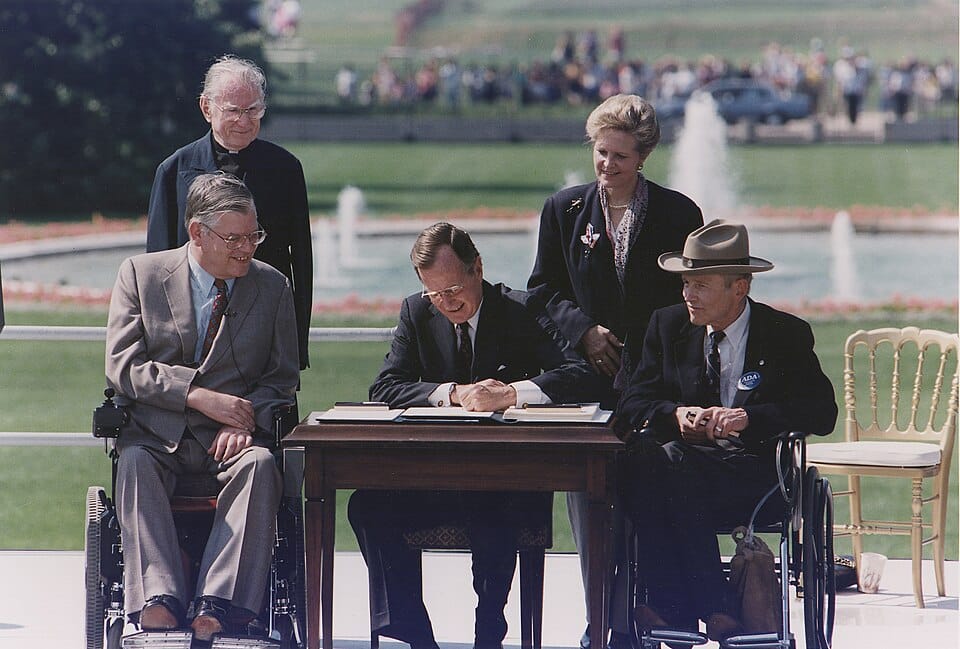
photo at top: Joyce Boghosian, Public domain, via Wikimedia Commons
You Might Also Like
Physiatry: An Introduction to PM&R
What is Physiatry? Physical Medicine and Rehabilitation (PM&R) physicians, also known as physiatrists, treat a wide variety of medical conditions that affect the central nervous system (the brain and spinal cord), the peripheral nervous system (other nerves), and the musculoskeletal system (the bones, joints, and associated soft tissues). Physiatrists have…

A Brief History of PM&R
In this podcast, Dr. Elizabeth Sandel gives a brief history of the medical specialty of PM&R. She outlines the major US and world events that helped to lay the foundation for physical and rehabilitation medicine. She emphasizes the role of early leaders such as Frank Krusen, Howard Rusk and others who helped to establish the field within organized medicine.
Dr. Elizabeth Sandel: Former AAPM&R Executive Discusses Critical Elements of the Field
In part one, Dr. Sandel talks about physical medicine and rehabilitation and it’s broad scope. In part two, she discusses her mission to educate the public about brain injuries, including concussion. In part three, she discusses what happens to the brain with concussions and repeated concussions. She ends with a case of a patient with a complex diagnosis after a traumatic event that required the diagnosis in order for the best treatment approaches.
Keep up to date
Get updates on the latest in concussion, brain health, and science-related tools from Dr. Elizabeth Sandel, M.D.
By clicking SIGN UP, you agree to receive emails from Dr. Sandel and agree to our terms of use and privacy policy.
Get the book!